Our Journey Begins in Alexandroupolis, Greece – Escape

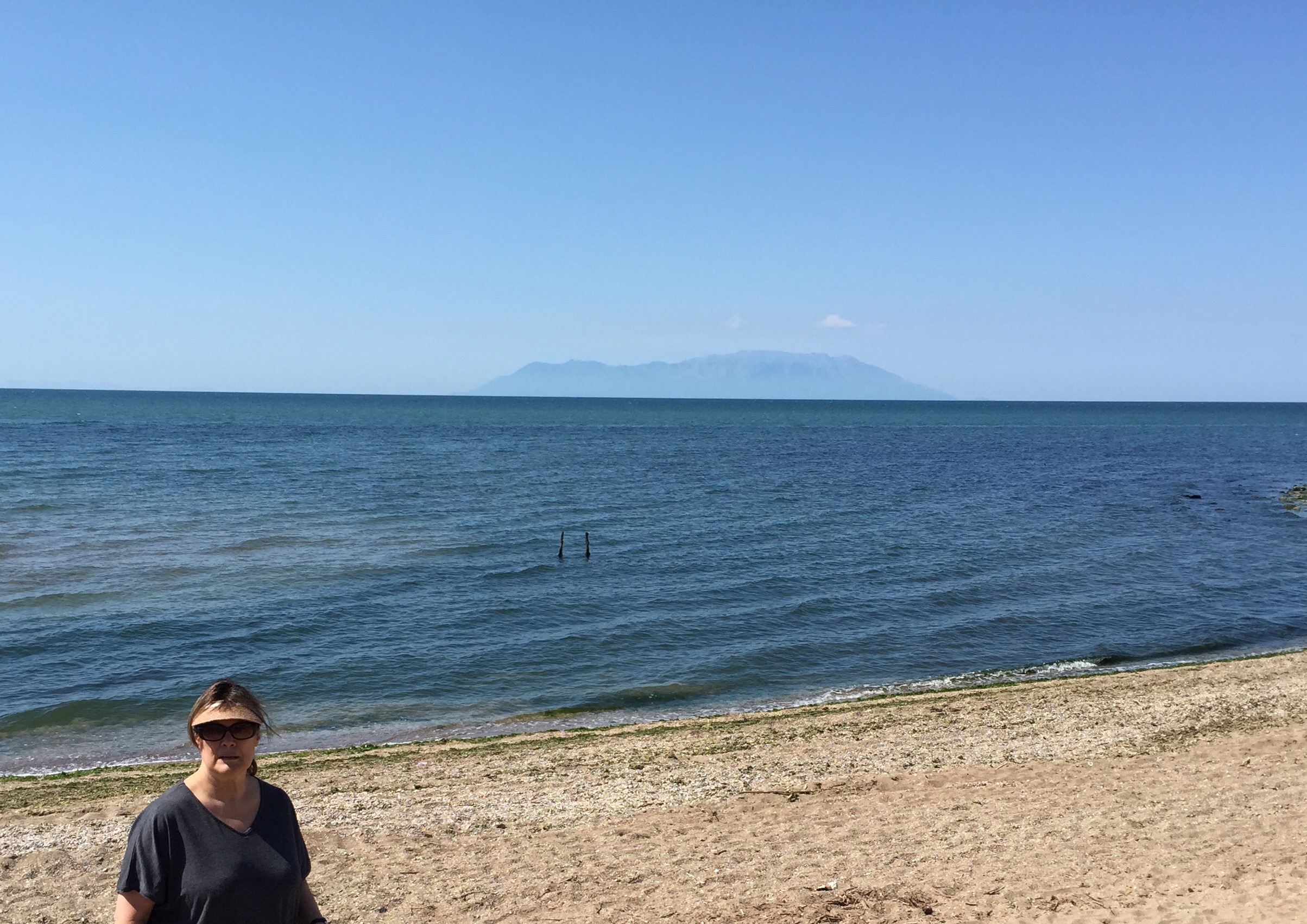
We walked barefoot on the beach, the gritty sand grains rubbed against our toes and soles, the same sand grains that witnessed the frantic efforts of four young men, 74 years ago, looking for an escape route from the German bombing of the harbor.

In the distance, the misty outline of the island of Samothraki was visible on this cool morning, about 30 miles out to sea. I stood still, an early morning quietness surrounded our thoughts, a breeze brushed my face and I let my mind take in the sights and feelings. The island was the first point of refuge for our father, John, in his path toward becoming a holocaust survivor, giving us all an opportunity at life. It was the the first stop on the route of his escape from the Nazis on March 6, 1941.
FullSizeRender

So, here we were, on the spot where he and three friends took in their escape route, jumped onto a barely floating boat they had stolen, and rowed for one and a half days, on the choppy Agean sea through the night, till they landed on the island. I heard my sister whisper, “What a monumental feat!”

I began to recall my father’s story:

“Avramico and I had rushed to the shore, looking for a boat to board. We saw a dingy about 50 feet off the shore. The sea was rough and it was bobbing up and down on the waves. “C’mon,” I yelled, “Let’s take that boat.” He slowed down, we were getting closer to the water as the tide pulled the waves further onto the beach. I turned and looked at him. His face was flushed, his eyes were black. He was having second merry-go-round thoughts, his expression told me so. His native pace slowed to a walk, he looked down. The agitated noise from the town square reached us and I knew what his decision was. “You go”, he said. “I can’t leave, my mother, the family,” tears rolling down his cheeks and I felt a sense of beleaguered loneliness engulf me.

There was no time, I shook his hand, said goodbye. I dove into the waves, swam for a few moments, then turned to look at him. My cap had blown off and was floating on the incoming wave close to where he was standing. He waded in a few feet, reached over and grasped it. He raised his arm above his head and waved my cap at me. I waved back at him. That was the last time I saw my favorite cousin, my best friend.”

We imagined the turbulence of his emotions, and they seemed to travel through time into our hearts. I gathered some pebbles, some broken shells, some grains of sand, and secured them in my zip lock bag, which I would take back with me, those objects which were a witness to our tragic family history.

The Jewish Museum of Greece & Our Start in Alexandropoulis

May 31, 2015

We began the soft part of our trip today, flew from Tel Aviv to Athens and then on to Alexandropoulis, where our father was born and grew up. This city is in Thrace, in northern Greece, an area that during WWII was “given” to Bulgaria by Nazi Germany.

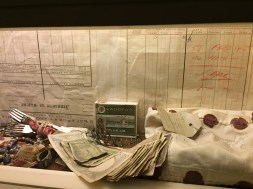
In Athens, we had the great fortune to visit the Jewish Museum of Greece, a jewel box of a museum with wonderful artifacts and a small but rich section dealing with the holocaust. Their eagerness to do everything they could to help us was both surprising and heart warming. The woman in charge of their archives, Anastasia Loudarou, and her team is dedicated to finding out and documenting as many facts as possible surrounding the events of the holocaust, and they are not even Jewish. They just believe it’s right. I am including these two pictures because they show the display in the museum of personal items that were stolen from Jewish homes in Thrace, where our family was living when the Jews were pulled out of their homes to be transported to the death camp. Maybe one or more of these items came from our family’s home.

IMG_0556IMG_0555

In Alexandropoulis we heard a concert in the Catholic church where a group of five musicians performed in honor of the diversity of peoples who were living in Trace during the Byzantine times. The music included Greek, Ottoman and Ladino pieces, one of which I recognized.

Vasilis Ritzaleo who has taken on the role of being our guide is immersed in the history of the Jews in the towns of Thrace. Although not Jewish, he is passionate about researching and bringing awareness to the history of the Thrace Jews in this area and country. There is so much to say about him, more about Vasilis on my next blog.

A Holocaust Survivor and The Next Generation

It has been 70 years since the end of World War II and the liberation of the camps. For some of us, their offspring, we are still consumed by the events of those six years, the aftermath of which continues to unfold in our lives and our psyches. For some of us, these 70 years are our 7 days of shiva in which we mourn those lost souls and wonder what might have been. For some of us, we feel compelled to understand why our parent was the way he was.

This is the story of a survivor, our father whose entire family was murdered in Treblinka, a man for whom the “final solution” DID happen. He overcame, lived a uniquely “successful” life but never faced his terrible grief. This is his story, and the story of the next generation, their journey to uncover the truth of who he was and why they became the tangled web of who they are.

The story begins in Xanthi, Greece with our journey, which will follow the same route forced upon our family, from the moment they were pulled out of their beds and homes at 3 am, on March 3, 1943 till their annihilation in the Treblinka Death Camp in Poland sometime around the end of March or beginning of April, 1943. It is a journey that will evoke an intensity of emotions that will be difficult to withstand.

We will endure whatever comes our way. The style of the journey will be modest, no 5-star hotels, no exotic restaurants, no souvenier shopping, just bare basics. Our transportation will include trains and buses because we want to travel on the same railroad tracks, breath the same air, see the same countryside that perhaps they might have seen, smell the smells that may have permeated the box car peep holes, immerse ourselves in this jet-fuel experience and maybe even sense their presence.

And write, till every emotion and every sensation is recorded. If they are out there somewhere, they will know that we, whom they never met, never loved, never hugged, but whom they might have imagined, are with them, that they are not forgotten, that their precious lives will be recorded into posterity. The book will be called, “A Soul’s Calling”, a book about a holocaust survivor and the next generation.